Why Typing May Not Be the Fastest Way to Communicate Anymore
We type almost everything these days, but our thoughts don't always move at typing speed. With voice and AI getting better, maybe the fastest way to communicate isn't typing at all — it's simply speaking.
Om Pandey5 min read
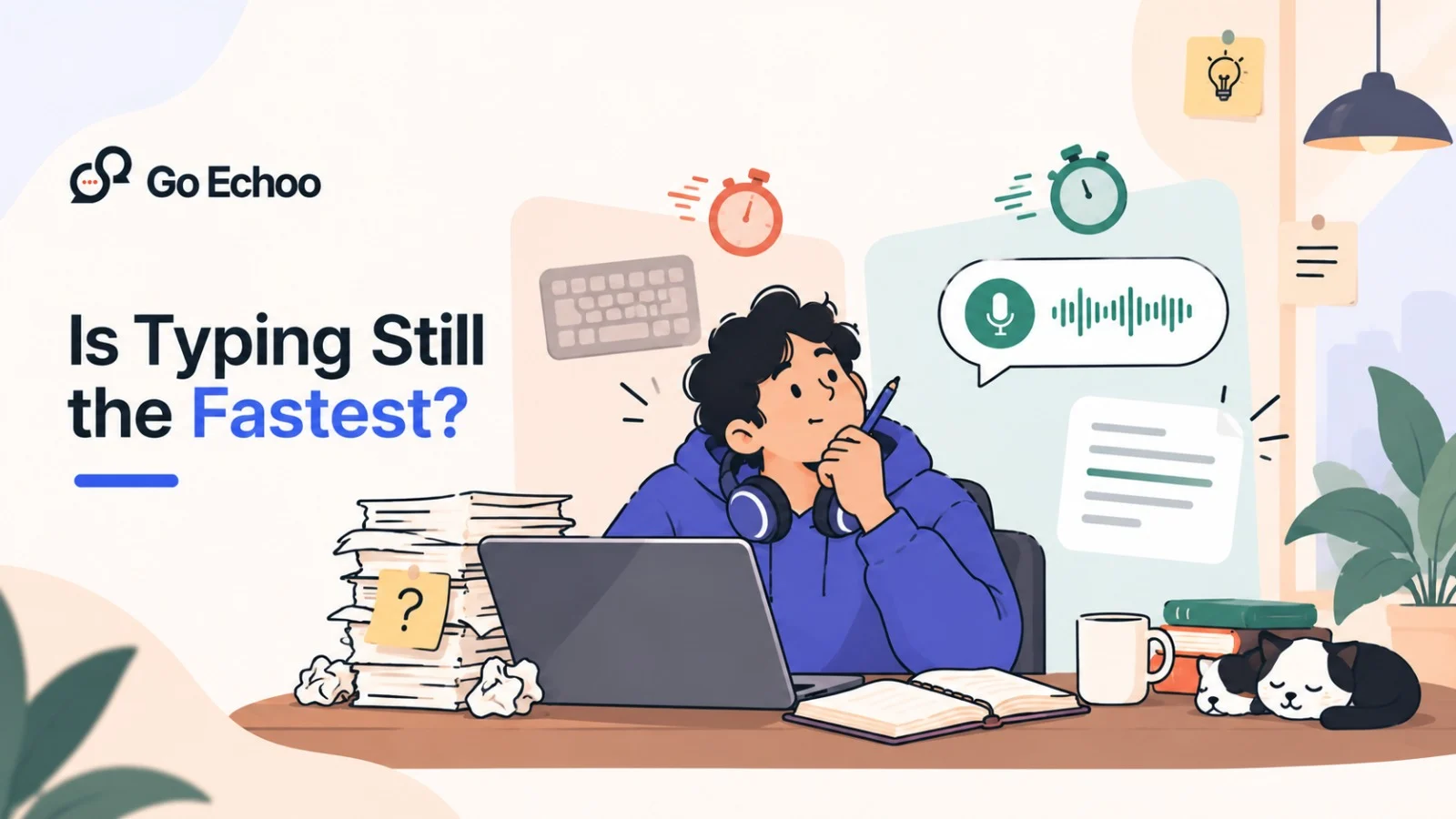
I type a lot. You probably do too.
Messages, emails, Google searches, notes, comments, documents… almost everything we do on a computer eventually involves a keyboard. And because we've been doing it for so long, we don't really question it. If we want to tell our computer something, we type it. Simple.
But while working on GoEchoo, I started thinking about something that sounds almost too obvious: why are we typing so much when we can speak much faster?
Think about how you normally explain something
If you are sitting with a friend and want to tell them a story, you don't plan every sentence in your head before saying it. You just start talking. You might stop for a second, change the sentence halfway through, or say, "Wait, that's not what I meant," and explain it differently. And that's completely normal.
Now imagine having to type that same conversation. Suddenly, you're thinking about every word. You type a sentence, notice a spelling mistake, go back and fix it, and then realize you forgot something, so you move the cursor back and add it. The thought was simple. Typing was the slow part.
And that's something I think we don't notice because we're so used to it.
Our fingers can't always keep up with our thoughts
This is probably the biggest reason I'm interested in voice. When you're typing, your thoughts have to go through your fingers before they reach the screen. When you're speaking, there's much less in the way. You simply say what's on your mind.
Of course, speaking isn't always perfect either. We pause, repeat ourselves, change our minds and sometimes completely lose track of what we were saying. But that's also how humans naturally communicate. We don't speak in perfectly formatted paragraphs. We just talk.
And for a long time, computers weren't particularly good at understanding that.
Voice typing has been around for years
This isn't a new idea. We've had speech-to-text on our phones and computers for years, and most of us have probably used it at some point. Sometimes it works surprisingly well. Other times... well, you look at the text it produced and wonder how it came up with that sentence.
That's been one of the biggest problems with voice. If I have to spend five minutes correcting the text after speaking for one minute, I haven't really saved much time.
So the real question isn't, "Can a computer turn my voice into text?" We've been able to do that for a while. The better question is, "Can it understand me well enough that I don't have to think about the technology?"
That's where AI is making things interesting.
AI is changing the experience
Modern speech recognition is getting much better at dealing with the way people actually talk. Different accents, different speaking speeds, pauses, long sentences, words that depend on context, and even switching between languages in the same conversation.
And that makes a big difference.
Because the goal shouldn't be to teach people how to speak to a computer. The goal should be to make the computer better at understanding people. That's a small difference in wording, but I think it's a pretty big difference in thinking.
There are so many situations where typing feels unnecessary
Think about when you're walking and suddenly remember something you need to send. Or you're working and an idea suddenly comes to you. Or you're trying to explain something complicated to someone. Or you simply have a long message to write.
In all of those situations, reaching for the keyboard can feel like an extra step. You already know what you want to say. Why should you have to slow yourself down just to type it?
You could just speak.
And that's probably where voice makes the most sense to me. Not everywhere. Not all the time. Just whenever speaking is easier than typing.
This is one of the ideas behind GoEchoo
While working on GoEchoo, this is one of the things that stood out to me. We aren't trying to convince people that keyboards are useless. They aren't. I still use a keyboard every day.
But I also think we shouldn't have to type every single thing we want to communicate. Sometimes I just want to say something and have it appear as text. No complicated process. No stopping to think about every word. Just speak normally and continue with what I was doing.
That's the experience we're trying to build with GoEchoo. It's less about replacing typing and more about giving people another way to communicate with their devices. A way that feels a little more natural.
I don't think typing is going away
And honestly, I don't think it should. There are things I would much rather type. Writing code? Keyboard. Editing a sentence? Keyboard. Entering a password? Definitely keyboard.
But there are also plenty of situations where I'd rather speak: writing a long message, explaining an idea, making a quick note, brainstorming, or just getting something out of my head before I forget it.
So maybe the future isn't about choosing between typing and speaking. Maybe it's about not having to choose.
Use the keyboard when it's useful. Use your voice when it's faster. Let AI handle the messy part in between.
Maybe we're finally getting closer to natural communication
For most of the history of computers, we've had to learn how to communicate with them. We learned keyboards, commands, menus, and where to click. But things are starting to move in the other direction.
Computers are getting better at understanding the way we communicate.
And I think that's a much more interesting future.
Because speaking isn't some futuristic technology. We've been doing it for thousands of years. The new part is that our computers are finally getting good enough to understand us.
So the next time you're about to type out a long message, maybe stop for a second and ask yourself:
"Would it be faster if I just said it?"
Sometimes, the answer might be yes.
And maybe that's where communication is heading.
Not toward typing faster.
Toward communicating more naturally.